Wednesday, April 3, 2013

I have an advanced copy of Stockman's book, "The Great Deformation" but have not had time to review the book because of my conference. I hope to get to the book next week, but it is an amazingly long 712 pages.

In reference to an op-ed piece by Stockman in the New York Times: Corruption of Capitalism in America, Krugman dismissed the ex-congressman as a "cranky old man" without even reading the book.
Actually, I was disappointed in Stockman’s piece. I thought there would be some kind of real argument, some presentation, however tendentious, of evidence. Instead it’s just a series of gee-whiz, context- and model-free numbers embedded in a rant — and not even an interesting rant. It’s cranky old man stuff, the kind of thing you get from people who read Investors Business Daily, listen to Rush Limbaugh, and maybe, if they’re unusually teched up, get investment advice from Zero Hedge. Sad.
Stockman Fires Back

Today MarketWatch reports Stockman Fires Back at Krugman, Critics. Here is an excerpt of the interview....
MarketWatch: Since Nixon’s “abomination” as you call it, we have had some periods where government spending to GDP actually went down, like during the Clinton era. Doesn’t that show it’s just the choices made by Congress rather than the Fed to blame [for rising debt]?

Stockman: There is the issue that Congress ultimately is the fiscal authority. But my argument is, when the Fed becomes a massive buyer of bonds and debt and artificially suppresses interest rate below market-clearing levels, it’s a terrible signal to the Congress that debt is cheap, that running deficits is a viable strategy. So therefore they are induced to kick the can, to let it drift and avoid hard choices. Who wants to tell the public you are going to take your broccoli of higher taxes and lower benefits and spending if you can issue debt on a three-year basis for 40 basis points. That’s free. I was in Congress, they don’t do decimal math, OK? And they think the money is free, it’s a bad problem philosophically, we shouldn’t be doing this for the great long run, but it’s no harm today.

Then they have professors like Krugman who give them the disingenuous advice that the bond vigilantes don’t care. The market is saying, “fine with us, we don’t care, keep piling the debt on, we love it.” That is so much baloney. The reason the interest rate on the 10-year bond 10_YEAR -0.33% today is 1.8% or whatever it happened to settle today, is the market knows the Fed is buying half of the debt and is front running the Fed. And it is renting the bond on repo, 98 cents on the dollar, based on overnight money that’s free thanks to Bubbles Ben as well.

For a so-called Nobel laureate to claim the vigilantes are validating this crazy deficit expansion through the fact the interest rate is 1.8% is the height of disingenuous.

MarketWatch: But Bernanke did a recent speech on this, and he pointed out the bond yields of every industrialized nation, including Germany, have dropped.

Stockman: You know why? Because every central bank in the world is putting out the same heroin, the same monetary policy poison. Because the Fed is doing this, and this is part of my theme in the book, that once we started going into the massive balance sheet expansion, other central banks had to reciprocate or otherwise their currencies would be disadvantaged.

The whole world of central banks is now administering the same bad medicine. To say it works because everyone is doing the same thing, again, I think is utterly disingenuous.
Nixon’s Abomination Explained

Wikipedia refers to "abomination" as "Nixon Shock".
"The Nixon Shock was a series of economic measures taken by United States President Richard Nixon in 1971 including unilaterally canceling the direct convertibility of the United States dollar to gold. It helped end the existing Bretton Woods system of international financial exchange, ushering in the era of freely floating currencies that remains to the present day."
I side with Stockman. Krugman is disingenuous, and closing the gold window was an abomination.

Deposit Insurance a Moral Hazard

Stockman claims FDIC deposit insurance is a "moral Hazard". Here is the pertinent snip from the interview.
MarketWatch: With what we’ve seen in Cyprus, doesn’t that argue for more and a more credible deposit insurance system rather than pulling back?

Stockman: No, I say deposit insurance is the great moral hazard. It’s what allowed the banks after we repealed Glass-Steagall to grow to this enormous magnitude and engage in all this speculation. And remember, Glass was opposed to deposit insurance, Steagall wanted it, Glass said, “OK, the quid pro is we’re not going to let the banks get outside the narrow walls of commercial banking.” Now when you repeal Glass-Steagall, you got the worst of both worlds. You got moral hazard of deposit insurance without the regulatory protections and separation of basically trading and gambling as Carter Glass would have seen it from deposit banking.

My argument is that if blue-haired ladies and timid people want to have safe places to save, create postal savings banks. Just a few government banks, they don’t earn any interest, and they get charged a penalty on their interest rate because the government’s credit is being used, but it’s safe, they sleep at night, and they can honestly save, because under a free-market interest rate the deposit rate would be helluva lot higher than today, half a percent under Bernanke imperialism.
Safe Way to Bank

I said nearly the same thing in Fraudulent Guarantees; Fictional Reserve Lending; Comparison of US to Cyprus; What About New Zealand?.

And the solution is so easy too. Open a bank that charges nominal fees for checking and makes no loans. Such a bank would not need loan officers or other high-priced personnel. It would offer safekeeping of money and simple checking accounts for a fee.

Those who want interest on their money should have to take a risk, the risk of a possible loss.

Finally, and as I have pointed out before, lending of checking accounts is outright fraud. Checking accounts are supposed to be money available on demand, but since Greenspan authorized Sweeps in 1994, almost none of it is.

Mike "Mish" Shedlock
http://globaleconomicanalysis.blogspot.com
Proving that fools never learn, the Obama administration pushes banks to make home loans to people with weaker credit
President Obama’s economic advisers and outside experts say the nation’s much-celebrated housing rebound is leaving too many people behind, including young people looking to buy their first homes and individuals with credit records weakened by the recession.

In response, administration officials say they are working to get banks to lend to a wider range of borrowers by taking advantage of taxpayer-backed programs — including those offered by the Federal Housing Administration — that insure home loans against default.

Housing officials are urging the Justice Department to provide assurances to banks, which have become increasingly cautious, that they will not face legal or financial recriminations if they make loans to riskier borrowers who meet government standards but later default.

Officials are also encouraging lenders to use more subjective judgment in determining whether to offer a loan and are seeking to make it easier for people who owe more than their properties are worth to refinance at today’s low interest rates, among other steps.
Here We Go Again

Mark Hanna commented "And Here We Go Again"

Indeed. Home markets are booming again so let's get everyone in on it.
The whiners are piling on already.
“If you were going to tell people in low-income and moderate-income communities and communities of color there was a housing recovery, they would look at you as if you had two heads,” said John Taylor, president of the National Community Reinvestment Coalition, a nonprofit housing organization. “It is very difficult for people of low and moderate incomes to refinance or buy homes.”

The FHA, in coordination with the White House, is working to develop new policies to make clear to banks that they will not lose their guarantees or face other legal action if loans that conform to the program’s standards later default. Officials hope the FHA’s actions will then spur Fannie and Freddie to do the same.

The effort requires sign-on by the Justice Department and the inspector general of Department of Housing and Urban Development, agencies that investigate wrongdoing in mortgage lending.
Proven Results

We tried this already. The results were not pretty, to say the least.

In spite of all the huffing and puffing by this administration, no one went to jail. Heck, no one was even prosecuted.

And now, after whining for more bank regulations, the White House wants even looser lending standards. Let's lower our standards so everyone qualifies for a loan. Again! And while we're at it, let's make the banks immune from prosecution! Then let's put taxpayers at risk via "taxpayer-backed programs" for the whole boondoggle.

This is all so obviously stupid that only a fool could propose it.

And a fool in the highest spot did just that.

Mike "Mish" Shedlock
http://globaleconomicanalysis.blogspot.com
Tuesday, April 2, 2013

Do you believe growth figures in China? What about the US, Canada, or Germany?

Actually, there is no reason to believe any GDP numbers. A recent email from Michael Pettis at China Financial Markets explains.

From Pettis ....
Last year China’s official growth rate was 7.8%, above the 7.5% target but the lowest number in many years and far lower than the more than 10% growth rates China had generated for the past two decades.

But even with the lower growth numbers throughout the year economists were puzzled by evidence that the economy was in fact growing more slowly than the official numbers suggested. Energy consumption in China, for example, usually grows more quickly than GDP, but surprisingly, in 2012 energy usage grew by only 5.5%, well below the official growth rate of 7.8%. Other indicators also indicated that growth may have been lower than the official numbers suggested.

While some of the sell-side economists still insist that China’s growth remained high and healthy enough, in fact among independent economists who specialize in the Chinese economy, both among Chinese and foreign economists there has been growing skepticism. A consensus is developing that China grew by less that 7.8% in 2012. For example Stephen Green at Standard Chartered, one of my favorites of the sell-side economists, refigured his numbers and guesses that instead of 9.3% for 2011 and 7.8% for 2012 (the official numbers), actual growth might have been 7.2% for 2011 and 5.5% for 2012. Other economists are suggesting even lower numbers, closer to zero.

I don’t have my own estimates because it seems to me that all of these attempts to measure economic growth are actually measuring economic activity, which may itself overstate growth. If you spend $100 million each on two separate bridges, one of which is actively used and the other rarely used, the official measures will have them contributing the same amount to GDP, even though the former creates real value and the latter does not. In either case if you then adjust the overall GDP numbers downwards by examining electricity usage, cement consumption, and so on, as the likes of Stephen Green do, you may end up with a more accurate estimate of economic activity, but you still treat the two bridges as contributing the same amount.

It isn’t until you write down the debt associated with the second bridge that you end up with a more meaningful measure of GDP. Of course this makes the whole process very confusing and it is hard to compare different estimates. It isn’t always clear how these estimates are reached, but as far as I can tell nearly all, if not all, of the downward revisions provided by various skeptical economists are still measures of economic activity, and do not include estimates for debt write-down associated with unnecessary investment.

We Know What To Do

There have been so many articles in the Chinese and foreign press about problems in the banking system that I won’t bother going through the topic much more except to note that Beijing cannot tolerate rapid credit growth and it cannot tolerate slow GDP growth. The problem is that it can only choose both or neither. There are no other options.

As credit concerns continue to rise, expect Beijing eventually to bite the bullet and stamp down on debt, in which case expect GDP growth rates to drop much, much more, in fact to well below anything we saw in 2012. The question is not whether this will happen, but when. Once Beijing is confident enough about its grip over vested interests and the consensus has developed within the leadership, growth rates will drop very sharply.

So this is probably why former Premier Wen is warning about the difficulty China faces in reforming the economy – a warning that he and Premier Li have made many times before but never more shrilly.

I have said often enough that we will be able to judge how resolute Beijing is and how capable of overcoming vested interests by how quickly credit growth is constrained and, with it, GPD growth. I expect to see high GDP growth (close to 8%) in the first half of the year but, if Beijing is able to move quickly, I expect growth to slow significantly in the second half.

If GDP growth does not slow, I will be worried about how long it takes the new leadership to get their arms around the problem that they clearly recognize (although perhaps still underestimate). The signals so far are good. Growth may be slowing even quicker than I had originally anticipated.

Does Cyprus matter?

I can’t really finish this newsletter without noting the astonishing events in Cyprus, especially since everyone in the world has already mentioned them. The concern most commentators have expressed is that by going after depositors the EU may have paved the way for bank runs in the rest of peripheral Europe. Quite a few analysts warned that we will begin to see this happen fairly soon.

I agree, but see it a little differently. The Cyprus proposal will probably have little impact on deposits now, but it will have an impact on memory. Depositors in the peripheral countries will remember what happened in Cyprus and it will affect their future confidence in the credibility of deposit guarantees.

We can imagine the “Cyprus effect” as a point on the credibility curve at which there is a sudden discontinuous or non-linear jump. As a country’s credibility declines, the deterioration in credibility was never likely to be smooth and linear because the process is self-reinforcing, but now we have added a sharp discontinuity. At some point of lower credibility, depositors, remembering Cyprus, will suddenly and sharply speed up their deposit withdrawal. And even if the original Cyprus plan is modified to protect small depositors, it probably won’t matter. The cat has already been let out of the bag.

Instead of embedding countercyclical mechanisms we have just embedded a big, fat, highly pro-cyclical pump into the credibility curve. It won’t matter so much now, but as things deteriorate, it will matter at some point, and of course always at the worst possible time.
Problem In The Definition

I italicized the key point. By definition, government spending contributes to GDP. No products have to be produced. Economic benefits are unnecessary.

Pettis used an example of governments building worthless bridges. Previously I have noted that if the government hired people to spit at the moon it would add to GDP. And that is an inherent problem with the definition.

In France, government spending accounts to 56% of GDP. How much of that spending is wasteful? How much government spending in the US is wasted?

Consider how Davis-Bacon and prevailing wage laws affect the answer. In the case of roads repairs, if the private market could do as good a repair job for 1/3 less, then the answer is 33.3%. But what about projects that should not be done at all?

Spending can even be net-negative as is the case in bombing countries for no reason. What did the US accomplish in Vietnam or Iraq? Even bridges to nowhere have more economic benefit.

While everyone is ready and willing to consider that China overstates its GDP, too few point the same finger at the US for the same reason.

Mike "Mish" Shedlock
http://globaleconomicanalysis.blogspot.com
As expected, economic news in France continues to worsen. The Markit France Manufacturing PMI shows final data French manufacturing sector operating conditions continue to deteriorate at a marked pace.
Key points:

PMI remains indicative of sharp downturn despite rising to three-month high
Output, new orders and employment fall further
Prices charged cut at fastest rate since November 2009

Summary:

Operating conditions in the French manufacturing sector continued to worsen in March. Although the headline Purchasing Managers’ Index ® inched up to a three-month high of 44.0, from 43.9 in February, it continued to signal a marked rate of deterioration.

The level of incoming new orders placed with manufacturers in France decreased further during March, extending the current period of contraction to 21 months. Moreover, the pace of decline accelerated slightly since February.

Reduced workloads prompted French manufacturers to cut staffing levels further in March. The rate of job shedding was solid, albeit the slowest in three months.

Prices charged by French manufacturers for finished goods fell for the third month running during March. Furthermore, the rate of decline accelerated to the sharpest since November 2009. A number of survey respondents commented that strong competitive pressures had weighed on their pricing power.

Comment:

Jack Kennedy, Senior Economist at Markit said: “A very slight improvement in the headline PMI figure does little to disguise an ongoing sharp deterioration in French manufacturing sector operating conditions during March. Increasingly aggressive output price discounting failed to prevent new orders dropping steeply remained deficient. Further marked falls in employment, purchasing and stocks also bear witness to a beleaguered industry struggling in the face of a darkening economic climate in France.”
Manufacturing vs. Production


click on chart for sharper image

The manufacturing PMI leads production and by implication GDP.

So guess where French GDP and the French budget deficit is headed. A trio of articles from the Financial Times will fill in a few of the expected pieces.

France Misses 2012 Deficit Target

As expected in this corner France Misses 2012 Deficit Target and it will miss its 2013 target as well.
Official figures showed the nominal deficit last year was 4.8 per cent of gross domestic product, overshooting the government’s target of 4.5 per cent. The 2011 deficit was also revised slightly upwards to 5.3 per cent.

The government has already acknowledged it will overshoot this year’s target deficit of 3 per cent previously agreed with the European Commission. With the figure now forecast to hit 3.7 per cent, France is seeking a year’s delay from the commission for reaching the target, the level at which growth in the public debt should stabilise.

The figures from Insee, the national statistics agency, showed the public debt, including France’s commitments to the eurozone’s rescue funds, rose to a record 90.2 per cent of GDP in 2012, slightly higher than target and up from 85.8 per cent in 2011.

France has not had a balanced budget since 1974 and is under strong pressure to cut its big public spending bill, which amounts to more than 56 per cent of GDP, the second largest in the EU.
French Unemployment Hits 16-Year High

Also as expected in this corner French Unemployment Hits 16-Year High
French unemployment nudged a record level in February as the jobless total rose for the 22nd month in succession to a 16-year high, adding to the acute political pressure on President François Hollande as he battles a stalled economy.

The number of people out of work actively seeking employment rose by 18,400 over the month to 3.18m, just shy of the record level of 3.19m reached in 1997, labour ministry figures showed.
Hollande Orders Employers to Pay 75% Tax

In the not expected but hardly surprising category, Hollande Orders Employers to Pay 75% Tax

In March, the French constitutional court disallowed Hollande's controversial top tax rate of 75% on individuals.

Proving that you cannot keep a dedicated socialist down, Hollande switched responsibility for paying the tax to employers. It was after all a "campaign promise". Why is it that idiotic pledges are the ones most likely to be met?

Supposedly the tax hike will last only two years.

Is it any wonder Top executives flee France for London, Belgium, and Switzerland?

Mike "Mish" Shedlock
http://globaleconomicanalysis.blogspot.com
The situation in Spain took another sharp turn for the worse. Employment losses are the greatest since 2009, tax revenue is declining, the deficit is increasing and the IIF wants economically insane tax hikes.

GDP Poised to Plunge, Deficit Poised to Rise

El Economista reports IIF believes that the Spanish economy will contract by 2% in 2013.
The Institute of International Finance (IIF) believes the Spanish economy contraction will accelerate to register a gross domestic product (GDP) decline of 2%.

"The decline in GDP seems likely to accelerate to 2% in 2013 after 1.4% in 2012, as high unemployment, tight monetary conditions and current lower wages further reduce domestic spending and weak demand contain domestic exports," said the IIF in a report on the eurozone.

The agency believes that this growth outlook "much weaker" have made ​​the agreed deficit targets for 2013 and 2014 are "unreachable", and believes that this year will close above 6%.

The IIF notes that the 2013 Budget predicted that the deficit falls to 4.5% of GDP this year down and 3% in 2014. "However, these growth forecasts for this year especially, seem unlikely," the report says.

In the current context, tax revenues will be lower than expected and that social spending will increase as a result of high unemployment. This will bring the deficit back above 6% of GDP, even if the government implements all the measures it has promised.

It warns the expiration of temporary tax increases such as income tax hikes approved by the Government in 2012, will cause the deficit to rise again in 2014 to 6.7%.

To ensure greater deficit reduction in 2014, the government needs to extend temporary tax increases more than expected or identify other measures to compensate their withdrawal.
Decline in Manufacturing Accelerates

The Markit Spain Manufacturing PMI shows Decline in manufacturing production accelerates in March.
Key Points:

Faster falls in output and new orders
Sharpest decline in employment since December 2009
Input costs decrease for first time in eight months

Summary:

March saw an accelerated deterioration in business conditions in the Spanish manufacturing sector,
with output, new orders and employment all falling at faster rates than in February. This contrasted
with business conditions coming closer to stabilisation earlier in 2013.

The seasonally adjusted Markit Purchasing Managers’ Index dropped to 44.2 in March, from 46.8 in the previous month. This was the lowest reading since October 2012, and represented the twenty-third successive deterioration of business conditions in the sector.

New orders fell at a steeper pace in March, with the latest decline the fastest since November 2012.
New export orders also decreased, ending a three-month period of growth. The rate of job cuts also
quickened, and was the steepest since December 2009.

Comment:

Commenting on the Spanish Manufacturing PMI ® survey data, Andrew Harker, economist at Markit and author of the report, said: “The March PMI data for Spain make grim reading for the manufacturing sector. Moreover, the latest figures have brought an end to the recent period of moderating declines, and cast doubt on any hopes of recovery for the rest of the year. The employment index again highlighted the extent of the problems currently afflicting the manufacturing sector and the wider Spanish economy, with jobs cut at the fastest pace in more than three years.”
The IIF wants Spain to hike taxes (extend temporary hikes if you prefer). Either way, the IIF is totally nuts. How long is Spain going to put up with this?

Mike "Mish" Shedlock
http://globaleconomicanalysis.blogspot.com

Monday, April 1, 2013

Today a judge ruled that the city of Stockton California is indeed bankrupt and that the city acted in good faith. Creditors asked the judge to void the bankruptcy, saying the city could raise taxes instead.

I have been watching this story for a while. Here is some background on the Stockton bankruptcy as reported by Arizona Central.
By outward appearances, Stockton, a city of nearly 300,000 on the Sacramento-San Joaquin River Delta, seemed in the mid-2000s to be emerging from decades of struggle.

After the city’s population grew by nearly 20 percent between 2000 and 2005 and real estate tripled in value, home prices plummeted 40 percent the following year before bottoming out at 70 percent.

Within two years, Stockton had accumulated nearly $1 billion in debt on civic improvements, money owed to pay pension contributions and the most generous health care benefits in the state — coverage for life for all retirees plus a dependent no matter how long they had worked for the city. 

By 2009, the city began slashing its budget to stay afloat. The police department lost 25 percent of its 441 sworn officers and the fire department was cut by 30 percent. City staff was cut by 40 percent. The city general fund budget, now $155 million, has been cut by $90 million over three years.

The impacts were felt everywhere. Wells Fargo bank seized three parking garages when the city defaulted on the $32 million in bonds that financed them. Bond holders also seized the $40 million downtown high rise that was to become City Hall.

Last summer, the city began negotiating with creditors, a requirement before entering bankruptcy. Ten employee unions agreed to temporary wage and benefits cuts.

Retired employees have also been asked to pick up a larger share of health care premiums, closing a $540 million retiree health care cost liability.

But the holders of the biggest share of the debt were the companies that in 2007 insured nearly $165 million in pension bond obligations to allow the city a lower interest rate and make them stable for investors. They were unable to negotiate a deal and want the city to avoid bankruptcy, which would likely allow Stockton to avoid repaying the debts in full.
City Acted in Good Faith

Today, Bloomberg reports a Judge Decided City Acted in Good Faith, Creditors Didn’t
The judge in a trial over whether the city of Stockton, California, can stay in bankruptcy said he found that the city negotiated in good faith with its creditors, and that the creditors didn’t.

Creditors, including Assured Guaranty Corp. and Franklin Resources Inc. (BEN) had argued that Stockton didn’t qualify for bankruptcy because the city isn’t truly insolvent, and that its leaders didn’t negotiate a potential settlement in good faith.

Negotiation is a “two way street,” said U.S. Bankruptcy Judge Christopher M. Klein in Sacramento, addressing creditors who he said didn’t negotiate in good faith. “You cannot negotiate with a stone wall.”

In the course of the hearing today, Klein has also said that the city’s witnesses were credible and that the city was “by any measure” insolvent when it filed for protection from creditors.

The city is slated to stop paying for retiree health care on June 30 as part of a spending plan the City Council approved in June, citing a $417 million unfunded liability. The benefit had allowed workers employed as little as a month to receive city-paid health coverage for life, for both the employee and his or her spouse, Bob Deis, the city’s manager said.

Stockton’s unemployment rate was 18.7 percent in January, almost twice the state jobless rate of 9.8 percent, according to the California Employment Development Department. The national unemployment level that month was 7.9 percent, according to U.S. Labor Department data.
This was a good ruling. The city is of course bankrupt and taxpayers should not have to pay for it more than they already have.

Once again the main problem was untenable salaries for public unions and city workers. The housing crash simply brought the crisis to a head sooner.

In addition to reduced healthcare benefits, the pension plan should be scrapped as well, but don't expect city officials to cut their own throats no matter how much they deserve it.

Mike "Mish" Shedlock
http://globaleconomicanalysis.blogspot.com
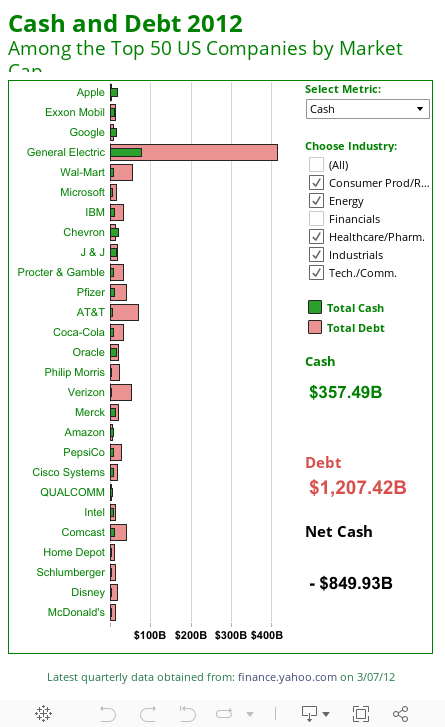
Here's the question of the day: How much actual cash is on hand at corporations?

Fed by glowing reports from sell-side analysts, most investors are unaware that except for a handful of companies, there is no cash, only debt. Even counting short-term investments there is surprisingly little cash on hand.

Courtesy of Mike Klaczynski at Tableau Software please consider the latest update to my periodic "Cash Cow" interactive report.


The data for this sheet is from Yahoo!Finance. Scroll over any of the bars (not the company name) to see more details.

Cash is a liability not an asset for banks, so I left off financial corporations in the default map. Certainly the $277 billion in cash on hand at Bank of America is not a sign of genuine strength or profitability. 

As you can see, actual cash on hand at non-financial corporations is a net negative $850 billion.

Five Cash Cows With Genuine Cash

  1. Apple (AAPL) $16.15 Billion 
  2. Chevron (CVX) $8.03 Billion 
  3. Google (GOOG) $7.57 Billion 
  4. Qualcomm (QCOM) $4.26 Billion
  5. Amazon (AMZN) $3.70 Billion

The grand total of actual available cash (at the five companies that have any) is $39.71 billion.

To add in short-term investments, click on the Select Metric drop-box that looks like this:


Here are the results.

10 Cash Cows Counting Short-Term Investments

  1. Microsoft (MSFT) $54.09 Billion
  2. Google (GOOG) $40.88 Billion 
  3. Apple (AAPL) $39.82 Billion 
  4. Cisco (CSCO) $30.09 Billion
  5. Oracle (ORCL) 13.94 Billion
  6. Qualcomm (QCOM) $13.24 Billion
  7. Chevron (CVX) $8.30 Billion 
  8. Amazon (AMZN) $7.07 Billion
  9. Intel (INTC) $4.59 Billion
  10. Johnson & Johnson (JNJ) $4.03 billion

Net Negative Cash

Counting short-term investments, net corporate cash of the 50 largest companies is negative $543.67 billion.

Total cash of the 10 companies that have positive balance sheet cash (counting short-term investments as a cash equivalent) is $216.05 billion.

This is a far cry from the $trillions in sideline cash we are told is ready to come pouring into the market any time now. The facts of the matter are:

  1. Sideline cash is a direct function of debt
  2. Sideline cash cannot come into the market to propel shares higher because for every buyer of a security there is a seller, except for debt offerings and IPOs

Yet, the concept of "sideline cash" as widely believed and highly touted by mainstream media is mathematically impossible.

It is possible however, for a corporation to use its cash to buy back shares, but in that case, sideline cash will be transferred to another account (frequently the cash account of an insider who is bailing).

Recall that investors wanted Apple to buy back shares last Autumn, thinking they were undervalued at $700. Today's price is $435.

Had Apple been foolish enough to buy back shares when everyone seemed convinced the next stop was $1000, Apple's share price would undoubtedly be lower today, reflective of the amount of cash it wasted on buybacks.

2009 and 2010 provided excellent opportunities for corporations to buy back shares. Bargains have long since vanished.

Mike "Mish" Shedlock
http://globaleconomicanalysis.blogspot.com
Global Economic Analysis BlogThe owner of this website is a participant in the Amazon Services LLC Associates Program, an affiliate advertising program designed to provide a means for sites to earn advertising fees by advertising and linking to Amazon properties including, but not limited to, amazon.com, endless.com, myhabit.com, smallparts.com, or amazonwireless.com.